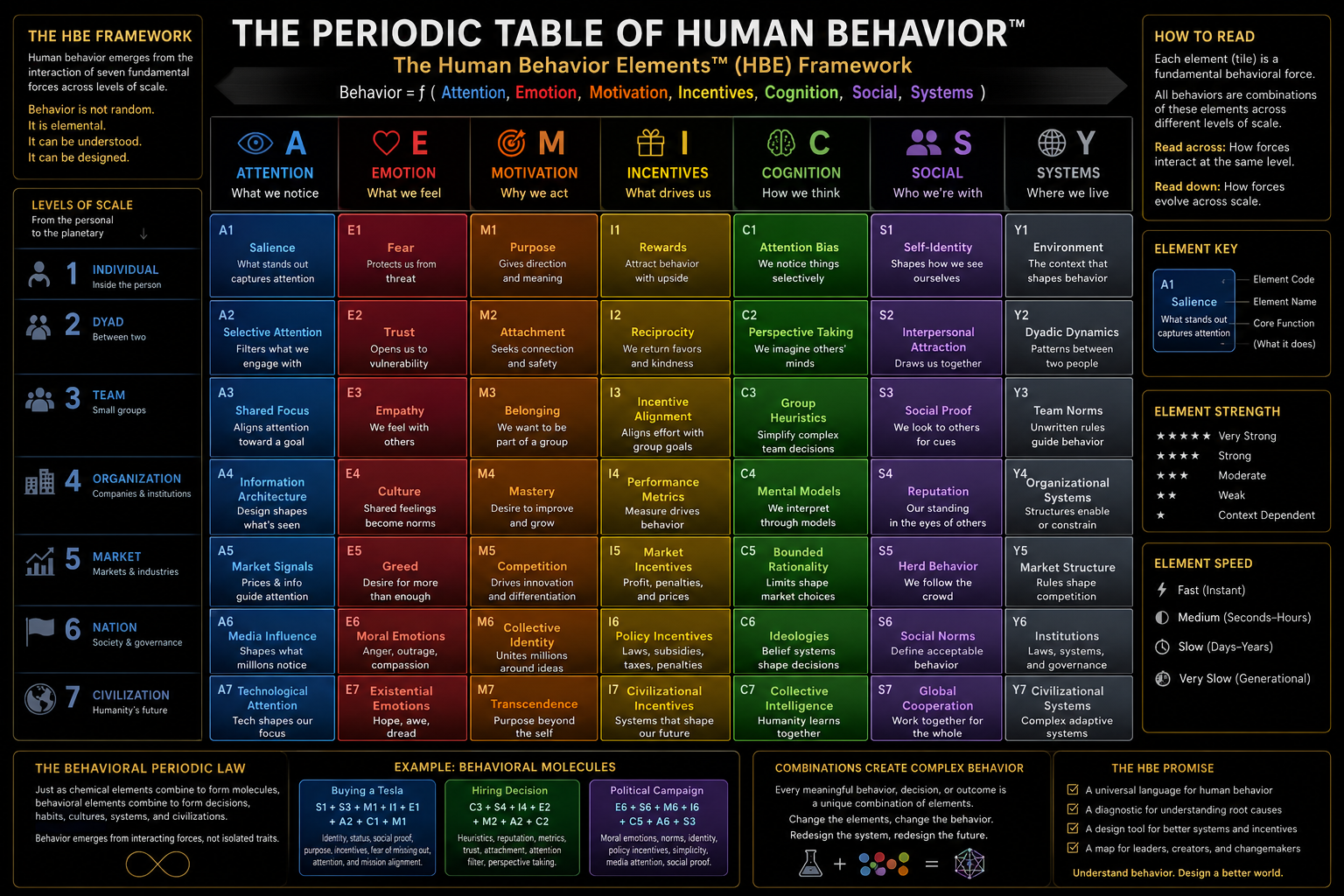
The Periodic Table of Human Behavior.
Hawkins · Maslow · SDT · Plutchik · Barrett · Kahneman · Cialdini · Spiral · Kegan
Nine foundational frameworks of human behavior, mapped to the 12 Dimensions and indexed into the Behavioral Data Lake that powers the Incentives LLM.
We built this researching perverse incentives — and realized behavior is elemental.
For two years we catalogued more than 200 perverse incentives — hospitals paid for procedures, teachers paid for test scores, agents paid for clicks. The pattern was never "people are irrational." The pattern was always the same forces, combining in the same predictable ways, at different levels of scale.
So we built a periodic table. Seven fundamental forces — Attention, Emotion, Motivation, Incentives, Cognition, Social, Systems — across seven levels of scale — from the individual to civilization. Forty-nine elements. Every decision, habit, culture, market, or institution is a molecule built from them.
Behavior is not random. It is elemental. It can be understood. It can be designed.
Tap any element to read its function, strength, and speed of change.
Every behavior is a combination.
Just as chemical elements combine into molecules, behavioral elements combine into decisions, habits, cultures, and systems. Change the elements — change the behavior.
Identity, status, social proof, purpose, incentives, fear of missing out, attention filter, and mission alignment.
Heuristics, reputation, metrics, trust, attachment, attention filter, perspective taking.
Moral emotions, norms, identity, policy incentives, simplicity, media attention, social proof.
From 7 forces to 12 dimensions.
The seven-force model was the proof of concept. Researching deeper — across neuroscience, evolutionary biology, complexity science, and culture — we found behavior actually emerges from twelve fundamental dimensions across seven levels of scale. The result: the full Human Behavior Taxonomy™ — 84 periodic-table elements backed by 1,180+ catalogued patterns, one unified framework.
Behavior = f(Cognition × Emotion × Motivation × Incentives × Identity × Social × Time × Environment × Biology × Systems × Culture × Consciousness)
Cognition, Emotion, Motivation, Incentives, Social, Identity, Time, Environment, Biology, Systems, Culture, Consciousness. Each one a column. Each one a force.
Individual → Dyad → Team → Organization → Market → Nation → Civilization. The same element behaves differently as it moves up the stack.
Every element can be exploited — and redesigned. The lens is built into every HBE page: detect, understand, measure, redesign, improve.
Don't just read the table. Run it on a real decision.
The 12 dimensions are inputs to four tools. Pick the one that matches what you actually need to do today.
Paste a policy, contract, comp plan, or product spec. Get the dimensions it activates, the perverse incentives it creates, and a redesign.
Build an incentive blueprint dimension by dimension. Collaborate, version, and cite back to the Atlas.
Run the Behavioral Equation. Move sliders across all 12 dimensions and watch the outcome shift. Share the run.
1,180+ catalogued patterns, every one with mechanism, evidence, and a perverse-incentive lens. The reference library.
The most comprehensive course on human behavior ever built — taught through the 12 dimensions.
Twelve weeks. Twelve dimensions. Every week you learn one force, run it through Lens, Designer, and Observatory on your own work, and walk out with an artifact you can ship. Week 11 is implementing the change in your team. Week 12 is Train the Trainer — because incentives are a culture, not a memo.
Decode the other side's dimensions. Design offers they cannot decline rationally.
Find the perverse incentives in your own org chart before they find you.
Stop motivating with willpower. Start designing the environment, the time horizon, the social proof.
Build products and comp plans where the right behavior is also the easy behavior.
Read contracts and regulations as behavioral systems. Predict the loophole before it's exploited.
Move past dark patterns. Design for the user's full 12-dimension stack — including the ones they don't notice.
Diagnose why programs fail at scale. Redesign with Goodhart, externalities, and identity in mind.
Give people a vocabulary for their own behavior — and a way to change it that actually holds.
- ✓A universal language for human behavior.
- ✓A diagnostic for understanding root causes.
- ✓A design tool for better systems and incentives.
- ✓A map for leaders, creators, and changemakers.
Understand behavior. Design a better world.